
RE-MINE
As the climate shifts towards disaster, unequivocally caused by decades of extraction and combustion, we continue to mine for the answers. In Northern Sweden, aside from contradicting the calls from the majority of the scientific community to scale back, this continuation also contradicts with traditional and native Sami practices. Their core value of ‘Leave No Trace’ has been practiced for hundreds of years and has, for their part, preserved the land in its natural state. This practice of conservation has been followed to the extent that the Sami’s right to their own land is hard to prove due to the lack of evidence left behind. Today, this contradiction remains, but as the cultures of Southern Sweden, Sami and other indigenous peoples, and global influence grow more intertwined, the question of how to approach the land, its resources, and how much of a trace to leave behind, becomes ever more complex.
This thesis uses the Leveäniemi mine as a canvas to explore the application of on-site reuse. The mine‘s role in extractive processes is countered (although comparitively small) by the proposed material banking, catalogueing, and on-site reuse. The mine also diverts a major artery of the reindeer herding migrational route along the seasonal Laevas Sami villiage. Taking inspiration from Sami Architect and Artist, Joar Nango,‘s concept of Indigenuity – Indigenous DIY using found objects and scrap – and recognising Nango‘s emphasis on similarities across cultures being the notion of real importance, this project uses the commonality of reuse culture in rural Sweden and Globally as the common ground on which a new purpose for this remote industrial site can grow. As such, the site‘s existing massive infrastructure is scoured for useful, interesting, unique, and banal parts, as if it were a local reuse scrap yard, and bodged together to form a new direction for the site that focuses on dismantling the site‘s current extractive purpose and transitioning into a regenerative and circular function.
The result is a small L-shaped new-build structure which showcases reuse as a main driver for design with passive environmental strategies incorporated and provides a community space for which new beginnings can emerge on the site. In further phases, a cluster of material banks, reuse workshops, soil and lichen research facilities, and ultimately rehabilitated to provide autumn-spring pastures for reindeer as they migrate back through the site.
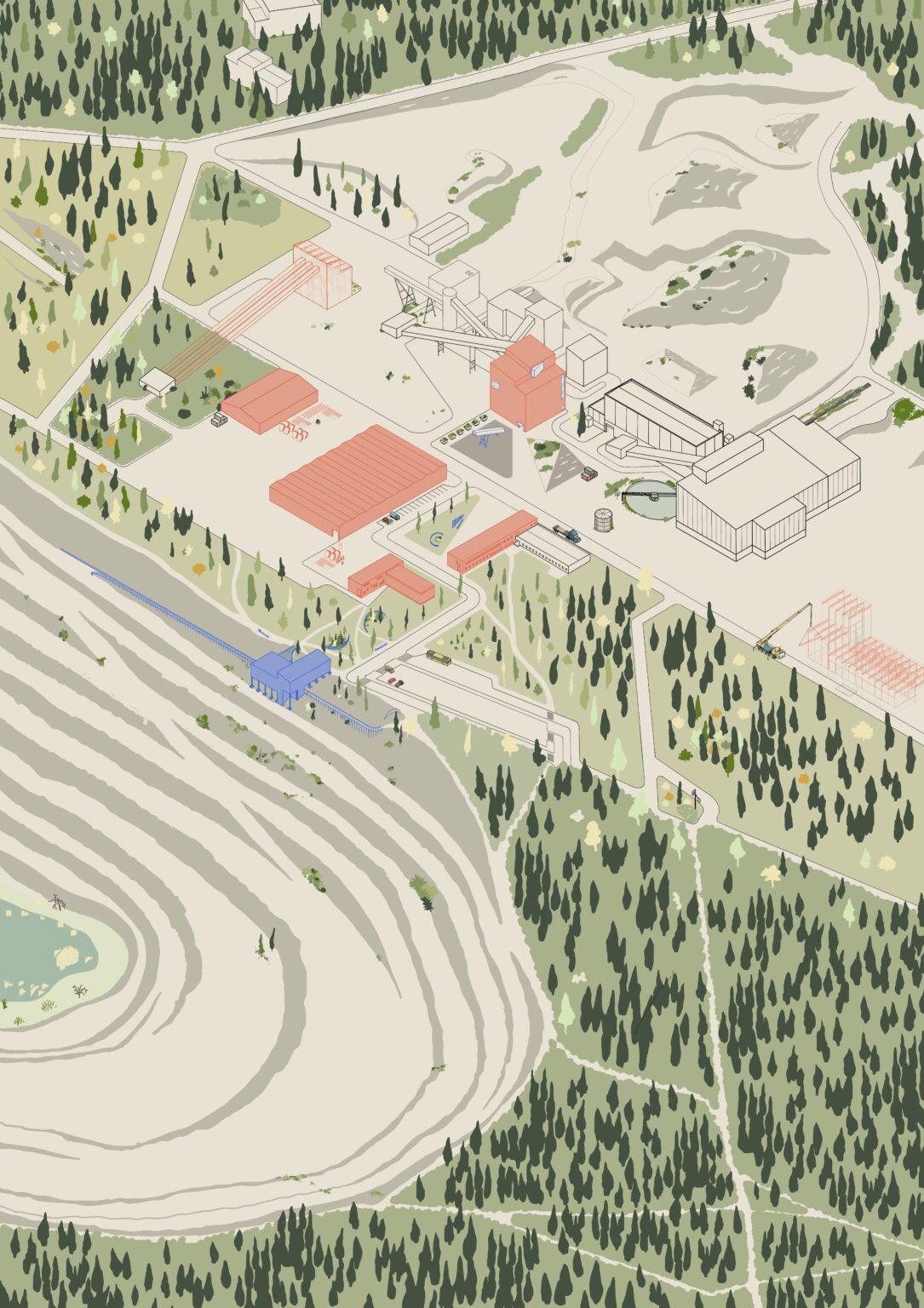
1:1000 SIte Isometric


Photograph of 1:2500 Compressed Earth and Aluminium Site Model


Photograph of 1:2500 Compressed Earth and Aluminium Site Model


