Self Initiated // Unspun*
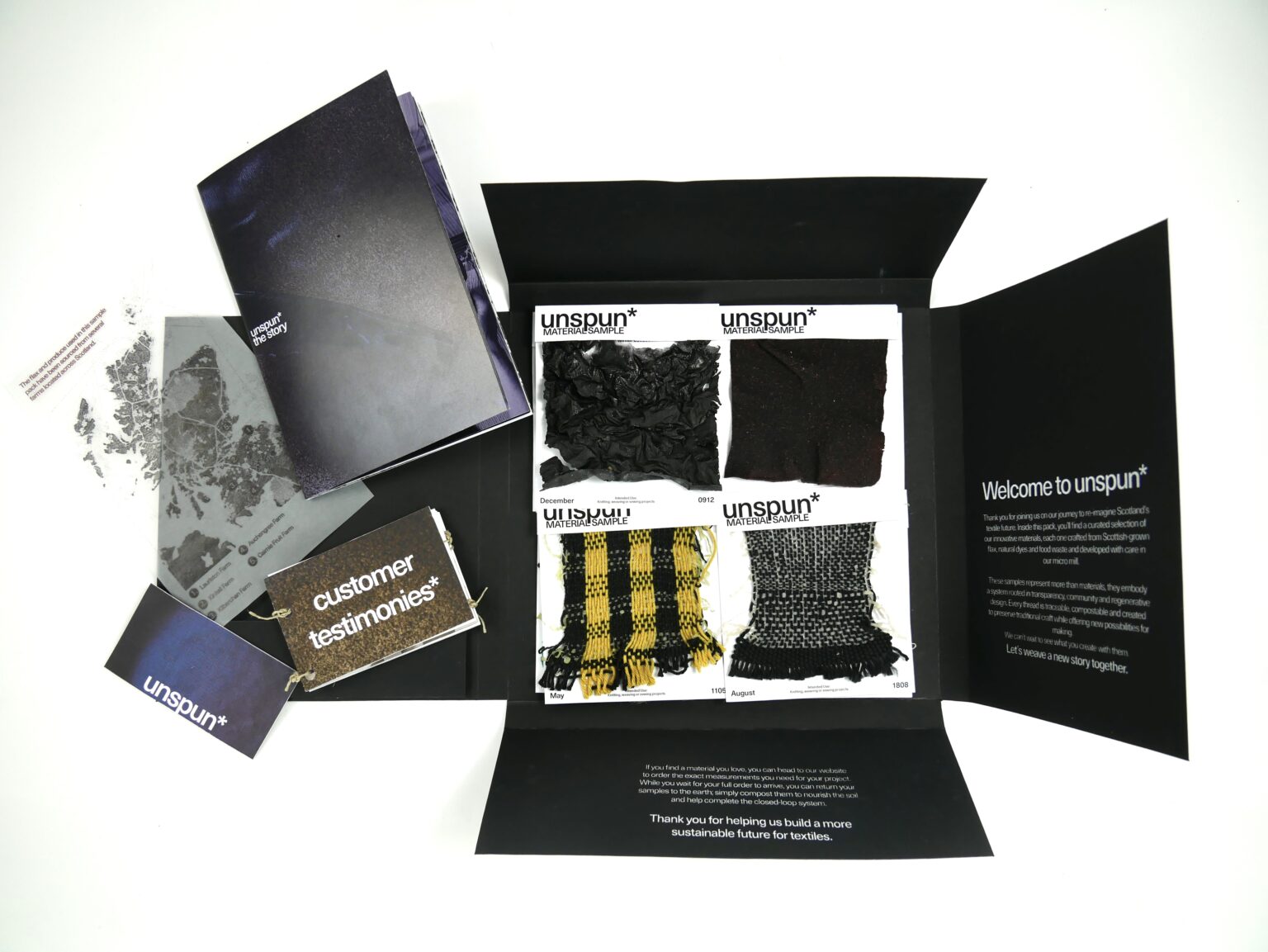
This project explores the potential of food waste and flax to form a new generation of bio-based yarns, reimagining how materials are made, used and valued. At its core, this work isn’t just about creating a sustainable yarn, it’s about developing a closed-loop system that connects material innovation with cultural preservation, local craft and regenerative practice.
The bio-yarn I’ve developed is made from vegetable-based dyes, flax, sodium alginate, sunflower oil, vegetable glycerin and is solidified using a calcium carbonate solution. All of these components are natural, renewable and carefully selected to create a soft, flexible and workable yarn that is entirely home compostable at the end of its life, returning safely to the soil and completing the cycle.
While others have explored food waste or flax independently, what makes this work innovative is the ecosystem around the material: a proposed ‘mill meets lab’ system that works on a local, human scale. It reconnects growers, makers and communities, creating a circular, transparent process that’s traceable from soil to final textile. This ‘mill’ becomes both a site of production and education, where people engage with the story behind their materials, learn traditional techniques and experiment with new ones. By embedding the material within this system, I aim to tackle several urgent challenges: material waste, loss of craft knowledge and a disconnect between consumers and production. Textile production is often invisible, industrial and extractive. This material and the process behind it, flips that model. It’s small-scale, visible and built on relationships. Equally important to this material’s development is its role in preserving Scottish craft traditions.
Techniques such as spinning and natural dyeing are at risk of being lost due to industrialisation and globalisation. My project seeks to revitalise these practices using future-facing materials. The bio yarn is not only usable by artisans, it invites them to co-create with it. Through workshops and prototyping, I’ve seen firsthand how the material encourages makers to explore new ways of working with heritage processes. The result is a dialogue between old and new, where tradition becomes a tool for innovation rather than nostalgia. Looking ahead, I believe this material and the system that supports it has real commercial potential. It offers brands and designers a local, low-impact alternative to synthetic and imported fibres, with a powerful narrative built in. From slow fashion to interiors and art textiles, the applications are broad.
As part of this vision, I imagine an open-source infrastructure where regional ‘mills’ can emerge in different contexts, adapted to local materials and crafts, but grounded in the same values of transparency, regeneration and care.
This isn’t just a yarn, it’s a proposition: What if the future of textiles wasn’t global, fast and linear but local, adaptive and circular? Through this project, I aim to prove that materials can be both innovative and regenerative, where nothing is wasted and everything returns to the land.
This project resulted in me being awarded the Material Innovation Award 2025, awarded to me by Weavers of Glasgow.